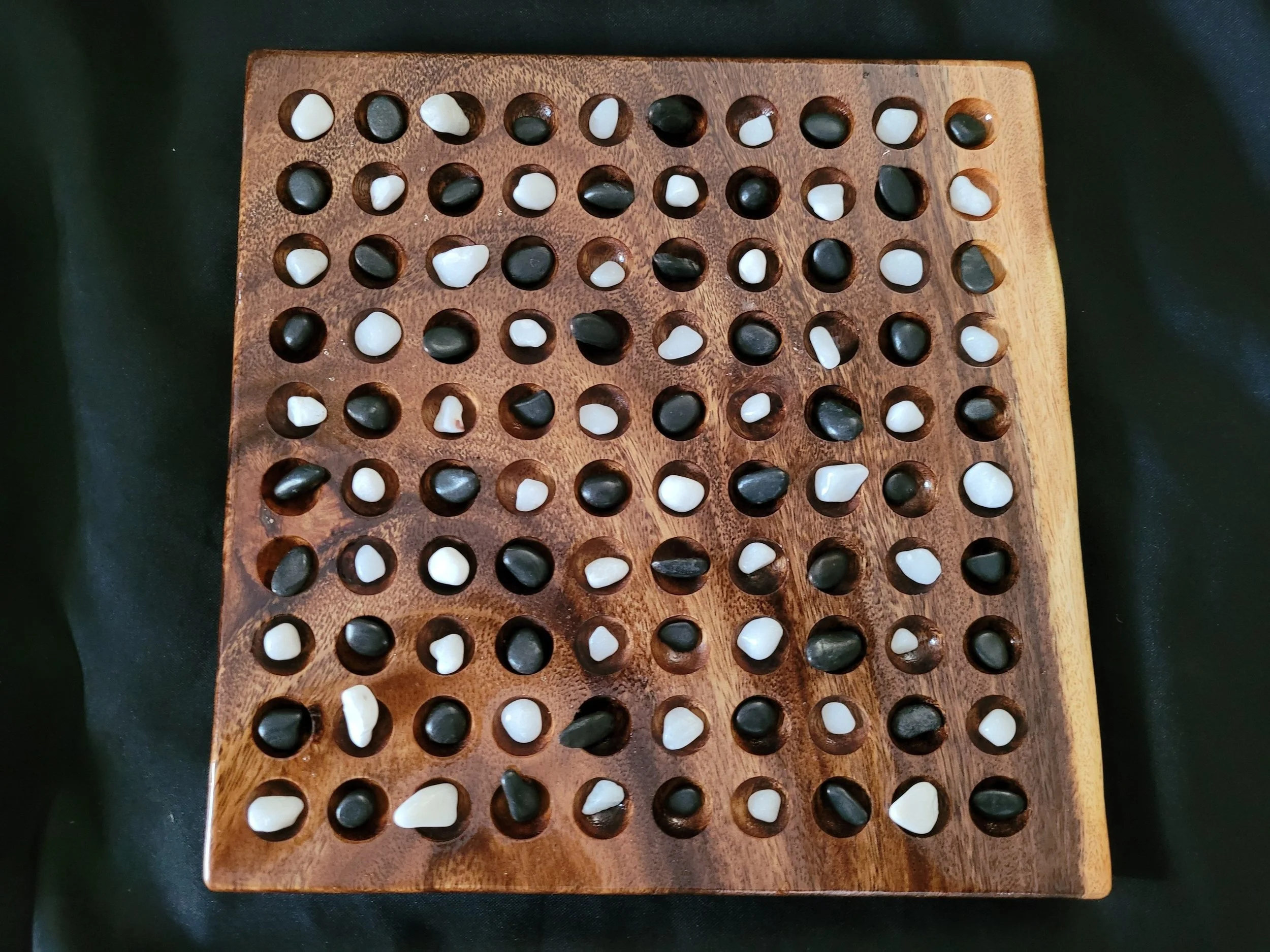
This is a Hawaiian game made, in this case, by native Hawaiians. The rules are etched on the back, which solves the problem of rules on a piece or two of paper. I'm not sure how traditional the laser etching is. The site shows a couple of other photographs. The board is taller than it looks here, a good slab of wood, with a tapered shape. Those are good white stones.
I don't talk much about konane, but I have a lot of respect for it. It's not a war game.
You would think photographing games is a matter of plunking down a board, tossing some pieces on it and snapping a picture. But it's more than that. In the beginning I had no idea about photography, particularly lighting, and, alas, there was nobody there to help me. It is tricky to get the bottom and top of the board to appear horizontal. Looking at the board at an angle solves that problem. You want to get a picture of a game in action. That requires actually playing a game, which is time-consuming work of a sort. After a picture is taken one often spots some annoying thing that went wrong, like pieces that are not perfectly allligned or a dirty board. These guys messed up alternating black and white stones. The background is another thing that has to be worked on.
The konane look is so simple, and yet for many years I couldn't determine a crafty board design. I like having the same type of pieces for both players. That makes it easier to set up the game. I've been poking at a board that is all uniform ocean blue, with white pieces (or ocean blue!). Positions would be identifiable because the board is corrugated, like a checkerboard with alternating directions rather than colour. A less innovative approach is to have blue cells alternating with striped blue and white. No pits.
Early in the history of Oak Games I made a konane with a wood board like above, but the holes had straight walls, not curved. The black and white glass pieces were put in upside down. Functionally this was not too bad. But it had a slick look, with the flat bottoms of the 64 glass pieces up.
I wonder if konane is not sold commercially because it can be done with a checkerboard. Well, with extra pieces.
Konane is almost certainly taught in Hawaiian schools. I wouldn't mind that class.
There was a time when I was pondering making an app for konane, which would include a new variant. Deep Blue Konane would not have edges; it would be borderless. So a piece jumping off the left side of the board would wind up on the right. Note that you can move the board, so it's not as brain bendy as you think. This would have a nice purity to it. I never did test this.
NEW I'm skeptical that the 6 x 6 board is much use, but I've never played it. For me the classic size is 8 x 8. A game will be under ten minutes if you know what youre doing. The 10 x 10 is fine. You're more scanning different parts of the board. For the bigger boards edge pieces are a lower percentage of the pieces.
NEW If you look around you can find nice pictures of konane boards on the Hawaiian islands that are slabs of volcanic rock.
You can see a game being played. Those tokens showing whose turn it is can be useful for games, especially if you are by yourself making moves for both sides and considering the moves of the other player. NEW The lady loses here, but, as I see it, you don't get the clear strangulation then lose because you're stupid that you get in chess.
These Hawaiian types explaining the game are passing on the ways of doing things from generation to generation and tying it to their culture. Or maybe someone just
made stuff up. I don't know.